General Rulesets
- General
- Pit & Course Conduct
- Start Line & Initiation
- Qualifying Format and Scoring Criteria
- Tandem Format
- Championship Points
General
## DEMEANOUR TOWARD OFFICIALS, STAFF AND/OR JUDGES
Every competition driver and team member has the right to ask questions and rationally discuss with the officials and/or judges, any issue pertaining to their performance, race operations, or the judging format. Any driver and/or team member that conducts him/herself in an inappropriate manner with the officials or judges will be subject to the same penalties as listed below.
*** GENERALLY before every event, we have a brief 15-20 minute window for drivers to discuss anything with the judges.
## DISQUALIFICATION
- Disqualification Applies to any Competitor, or Team for technical or driver infractions.
- It can also include loss of all points, trophies and prize money and any additional awards.
- Disqualification will be written on the amended official results.
- Awards and prize money will be adjusted by Spec-D accordingly.
## SERIES DIRECTOR
The Series Director shall be the executive responsible for the general conduct of all aspects of competition at an event for which he/she has been assigned including conduct of participants and officials, on-course safety issues, application of the Spec-D. Rules and Regulations. He/she shall ensure that all provisions of these rules are conformed to.
The Series Director has the authority disqualify or penalize any vehicle that does not conform to the requirements of the Rules and specifications of the Series. In the event of an infraction, it is the duty of the Disciplinary Committee to take appropriate action as provided for in these regulations.
The Series Director has the “right of first refusal”. If a team interprets a rule in such a way as to prepare a vehicle beyond the intent of the rule, the Series Director may disallow the preparation and issue an immediate clarification.
## JUDGES
Judges are responsible for determining scores and points assigned to individual or team competitors based on the competition criteria determined Spec-D.
Judges or other entities as assigned by Spec-D will also compile and distribute official results (after notification that all protests are completed and that the Scorer and one official judge has declared the results “official”) for all qualifying and head to head battles.
Pit & Course Conduct
## 5. 1. GENERAL PIT, PADDOCK, AND COURSE RULES
Once practice is officially declared over and qualifying / competition is about to begin, the following rules will be implemented:
- Revving of engines, bouncing off the rev limiter, and burnouts while not on course will not be tolerated.
- No driver may enter a “hot” course without approval from the Race Control.
- The Series Director or his/her delegate is the authority in enforcing start line, grid, pre-grid, paddock, and the competition course.
Start Line & Initiation
## 5. 2. START LINE PROCEDURE
The start line is situated at the beginning of the course and is often marked. It is the official starting point of each qualifying run and tandem battle. The start line official, which signals when the vehicle(s) can leave the start line. During both qualifying and tandem battles, there may be a chicane that is designed to require the lead driver to lift off the throttle momentarily after leaving the start line. This chicane is in place to slow the lead driver down off the line and allow the chase driver to maintain proximity down the straight away leading up to initiation. It is outlined with cones to make it visible to all drivers. If the lead driver hits one or more cones within the chicane during a tandem battle, the battle will be halted and restarted via a flagger or restart light posted trackside prior to initiation. The location of the flagger or restart light will be discussed during the driver’s meetings prior to competition.
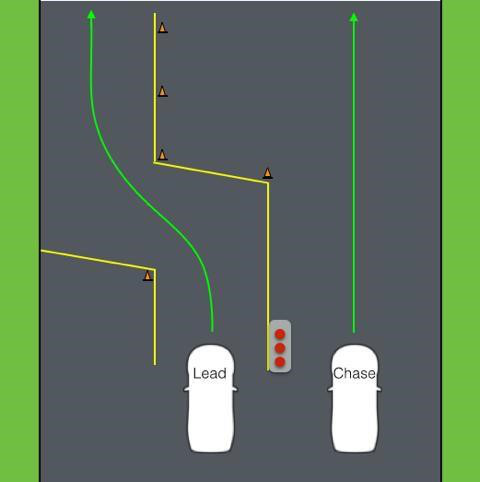
During tandem, if the lead driver hits one or more cones out of their position, in anyway on the first start, there will be a restart. If the lead driver hits one or more cones on the second start, there will be a restart. If the lead driver hits one or more cones on the third start, the lead driver will be given an automatic INCOMPLETE. Judges or Officials may call a restart based on criteria discussed in the drivers meeting.
## 5. 3. INITIATION
During both qualifying and tandem the vehicle must be sideways as it passes the single standing cone in the “3, 2, 1” cone sequence placed trackside. For the additional Tandem procedure see TANDEM INITIATION PROCEDURE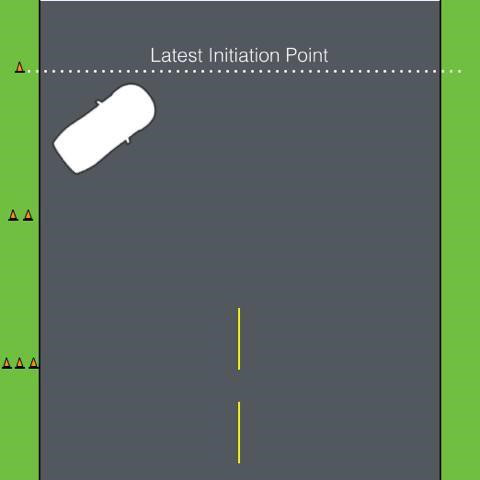
If the track chosen for competition has no marked initiation line, appropriate discussion will be had prior to competition beginning.
Qualifying Format and Scoring Criteria
## 5. 4. QUALIFYING FORMAT
Drivers will complete two consecutive runs on the course in order of car number.
DURING QUALIFYING:
8 Drivers at a time will be in queue in the lobby to do their runs.
This is to ensure server stability and reduce latency among drivers (stable ping)
Drivers may disconnect after both runs have been completed and an official score given.
NO OTHER DRIVERS WILL BE ALLOWED IN THE LOBBY.
## 5. 5. QUALIFYING OVERVIEW
Qualifying is supposed to establish what a good lead will look like in tandem. Committed, aggressive runs that give the chase driver a challenge to follow, due to the technicality of the run are ideal. For example, the judges do not want to see the lead driver driving fast and shallow in order to run away from the chase driver. Another example of what not to do, is the lead driver parking the chase driver around inside clipping points.
## Line, Angle and Style Scoring Details:
Line and Angle scoring will deal only with the zones, clips and touch-and- go areas and how the Line and Angle of the vehicle are performed and executed in these areas. Style will deal with scoring all the areas not contained within the zones and clips. In these areas the Style judge will be watching for Commitment and Fluidity and linking together the course with proper execution from initiation to zone to clip to zone to finish, etc. The portion of the course from the start line to initiation is also contained within Style.
Examples:
Bobbles, mistakes, wall taps, etc. that cause a reduction in Line and/or Angle that happen in a zone, touch-and-go, or at clipping points will result in a deduction of points for either Line, Angle, or both.
Style will look at how the vehicle behaves in the areas between clipping points, zones, and touch-and-go’s, as well as leading up to and through initiation.
The setup for a transition, the transition itself and how settled the car is post-transition, as it heads to a scored area for line & angle is what is being looked at here for the Style judge. Is the driver using their momentum to set up for an upcoming outside zone, or are they approaching it tentatively and then jumping on the throttle? Does the approach to an outside zone outlined by a wall look aggressive and committed? Did the driver attain a low amount of angle on transition between an inside clip and an outside zone and then have to add more angle before entering the zone? Does the driver have poor accel/decel management? These are some of the example questions the Style judge will want to answer.Scoring Reference Guide:
Style (30 points)
Commitment - Forward motion of the vehicle
- Aggressive on throttle to initiation
- Initiation (back on throttle quickly, initiation before latest initiation point, quick rate to angle, smooth)
- Approaching walls and track edges with confidence
- Maintaining proper pace (as per the accel/decel map) Fluidity - Motion of the vehicle on its own axis
Initiation (smooth, quick rotation, no corrections).
- Rotation quickness (quick or lazy)
- Rotation smoothness (smooth or choppy)
- Rotation accuracy (was the right amount of angle achieved? Too much or too little, that required a correction either way to maintain drift and/or the desired line)
- Maintaining a smooth radius from zone to zone or approaching a clip
Line (30 points)
Judged in outside zones and at inner clips, based on vehicle’s proximity to marked areas. Where walls are present, line will be judged on the proximity of the bumper to the wall. Where no walls are present, line will be judged based on tire’s proximity to the track edge and or inside clips.
Angle (30 points)
Judged in outside zones and at inner clips. Based on the angle of the vehicle compared to the direction of travel.
X-Factor (10 points)
Wow factor of the run.
All three judges will independently pick a wow factor score out of 10 total points.
The average out of the 3 independent scores will be calculated and represented as the final X-Factor score.
DEDUCTION EXAMPLES
- Double initiation
- Tire off course
- Missing zones and clips
- Straightening
- Off line
- Lack of Angle
## 5. 6. INCOMPLETE QUALIFYING RUNS
If a driver does any of the following mistakes in a qualifying run, the driver will not receive a score for that run and therefore the run will be considered
INCOMPLETE
- Spinning Out
- Opposite drift - Drifting with the opposite angle required at that point on course
## 5. 7. QUALIFYING TIE BREAKER
In the event of a tie in qualifying the following chart will be implemented.
| Tie Breaker | |
| 1 | High Qualifying Score (HQS) |
| 2 | Low Qualifying Score (LQS) |
| 3 | HQS Style Score |
| 4 | HQS Angle Score |
| 5 | HQS Line Score |
| 6 | LQS Style Score |
| 7 | LQS Angle Score |
| 8 | LQS Line Score |
Tandem Format
## 5. 8. TANDEM ELIMINATION FORMAT
The Top 16 Qualified drivers are placed in a standard bracket based on qualifying position. The tandem battles are single elimination head-to- head battles consisting of two runs per battle with the winner moving on in the bracket.
The higher qualifier will always lead the first run.
## 5. 10. TANDEM JUDGING CRITERIA
Judges are looking for the driver that performs better overall in the tandem battle, but if the judges are unable to find a clear winner, a One More Time (OMT) is called. The Judges will watch both Run 1 and Run 2. They will also compare both lead runs and both chase runs and then determine which driver was the better overall driver once both runs have been completed.
LEAD DRIVER GOALS:
- Run the qualifying line
- Run a 100 point qualifying run
- Run a chase able lead run
- Follow the Accel/Decel map
LEAD DRIVER COMPROMISES:
- Less angle than the ideal qualifying run
- Tighter line than the ideal qualifying run
- Poor transitions
- Trying to get away from the chase driver in any way that compromises line, angle or style.
Chaseable lead run will have filled the zones, hit the clips and maintained a consistent speed and/or slowed/braked in the proper areas, which gives the chase driver a reasonable opportunity to chase and mimic with good proximity.
Un chaseable lead run will have a variety of errors and or deductions that make it difficult for the chase driver to mimic or keep up with while in drift.
A lead run filled with compromises will be a run with a disadvantage, all other things being equal.
CHASE DRIVER GOALS:
- Initiate no later than the lead driver
- Maintain close proximity to the lead driver with as much duration as possible
- Match or better the lead driver angle
- Mimic the lead driver transitions and line throughout the course
CHASE DRIVER COMPROMISES:
- Cheating the line compared to the lead car
- Cheating angle compared to the lead car
- Timing and location of initiation
- Timing of transitions and overall driving compared to the lead car
The chase driver goal is to complete the course with as much proximity to the lead driver as possible, while mimicking the lead driver’s angle, line and transition points and style. The chase driver must initiate no later than the lead driver, make no corrections or mistakes, and remain in drift until the finish line has been passed to show his/her abilities in comparison to the other driver. A chase driver that does not establish and maintain proximity may be at a disadvantage.
A chase run filled with compromises will be a run with a disadvantage, all other things being equal.
## 5. 11. INCOMPLETE TANDEM RUNS
If a driver does any of the following mistakes in a tandem run, the driver will not receive a score for that run and therefore the run will be considered incomplete
The following constitute an INCOMPLETE in tandem:
- Spinning Out
- Opposite drift- Drifting with the opposite angle required at that point on course
- Hood, hatch, trunk and/or doors opening during a run
- Collision with the other driver that is considered “avoidable” or unsportsmanlike
- A chase driver intentionally not chasing the lead driver after an INCOMPLETE was scored on the previous run.
- Three consecutive restarts from chicane cones or an official’s call
- Performing an Illegal pass - results in an INCOMPLETE for the chase driver
- Getting legally passed- results in an INCOMPLETE for the lead driver
## 5. 12. PASSING
Passing is allowed in Spec-D tandem battles. Passing is not required, but is legal for the chase vehicle to do as long as all four of the following conditions are met:
- The lead driver must be offline or completely off course
- The chase driver can only make a pass on an inside clipping point.
- The chase driver can only make pass on the inside of the lead driver.
- The chase driver becomes the lead driver once the chase vehicle has fully surpassed the lead driver’s vehicle.
Upon completion of a properly performed legal pass, the chase driver will become the lead driver and must complete the run according to the judging criteria. Once the run is completed the vehicle that was passed will receive an INCOMPLETE on that run.
Championship Points
QUALIFYING POINTS
| 1st | 8 pts | 5th |
4 pts |
| 2nd | 7 pts | 6th | 3 pts |
| 3rd | 6 pts | 7th | 2 pts |
| 4th | 5 pts | 8th | 1 pt |
COMPETITION POINTS
| 1st | 100 pts | 5th thru 8th | 48 pts |
| 2nd | 88 pts | 9th thru 16th | 32 pts |
| 3rd | 76 pts | 17th thru 32nd | 16 pts |
| 4th | 64 pts | 33 and beyond | 0 pts |
CHAMPIONSHIP RANKING TIE BREAKING
If a tie occurs in the points standings- the tie breaker will be the finish rank of the most recent round.
Example: Driver Y and Driver Z both have 212 points at the end of the season, Driver Y finished 14th and Driver Z finished 13th in the most recent round. Driver Z will be will be ranked above Driver Z